
Commercial roof surveys: the true picture before any work is agreed
Most roofing problems are diagnosed too late because no one looked properly until something failed. A thorough survey tells you the condition of what is there, where it is failing and why, what the realistic options are, and what each one costs. That is the only sound basis for a decision about a commercial roof.
Nova surveys before it specifies. We inspect the roof, write up the findings, set out the options with costs, and hand you the report before any work is agreed. Surveys are quoted as a fixed fee before we attend. If you appoint us to carry out the work the survey recommends, the fee is credited against the contract.
What a Nova roof survey covers
Our preferred first step is a drone flight over the whole roof. It shows the condition of the surface without anyone walking fragile sheets or closing the building below. We use the footage to plot areas of concern, then inspect and photograph those areas at close range where access is safe. If weather or airspace restrictions prevent a flight, we work from annotated satellite imagery combined with roof-level inspection.
Drone flight and close inspection
Our preferred first step, with annotated satellite imagery and roof-level inspection as the fallback when weather or airspace restrictions prevent a flight.
Physical detail inspection
Penetrations, junctions, upstands and drains assessed at roof level where access is safe. Finds what aerial imagery cannot capture on its own.
Written condition report
Your findings in writing: defects identified, their location and probable cause, a condition assessment, and a clear recommendation. Delivered within five working days.
Costed options
Every recommendation comes with the cost and expected design life of each realistic route forward, so the decision rests on evidence rather than a sales pitch.
Estate and portfolio surveys: For multi-site portfolios, every roof is surveyed and a single consolidated report returned with a red, amber and green condition rating and a cost plan per site. One document covers the whole estate.
Which type of survey do you need?
The right survey type depends on why you need it. The five types below cover the full range of commercial and industrial survey requirements. Commissioned condition surveys, dilapidations schedules and acquisition reports are quoted as professional services in their own right, with the scope and fee agreed up front. If you are not sure which applies, a condition survey is almost always the right starting point.
| Survey type | When you need it | Report outcome | Report from inspection |
|---|---|---|---|
| Condition survey | Understanding the current state of a commercial or industrial roof. The standard starting point for any owner or occupier who wants to know what they have and what it will cost to maintain or improve. | Written condition report, prioritised recommendation, costed options. Most common | 5 working days |
| Pre-works survey | Before a refurbishment, overcladding or replacement project, to confirm the exact scope of works and the structural condition before the contract is signed. Removes scope risk upfront. | Confirmed scope of works, structural condition assessment, risks identified before commitment. | 5 working days |
| Dilapidations survey | Lease end, landlord and tenant dispute, or sale of a property, where a point-in-time condition record with legal defensibility is required. | Condition record with dated, annotated photographic evidence. Written with legal and evidentiary requirements in mind. Construction law qualified | 5 working days |
| Insurance and reinstatement survey | Insurance purposes, or to document condition and scope following an insured event. Produced in a format your insurer and loss adjuster can use directly. | Condition report in insurer-ready format with annotated photographic record and scope of reinstatement works. | 5 working days |
| Estate and portfolio survey | Multiple buildings, capital planning, or estate management. When you need the full picture across all sites in one place rather than a separate report per building. | Consolidated report with RAG condition rating and cost plan per building, covering the whole portfolio in a single document. Recommended for estates | Agreed programme by site count |
How it works
From first contact to written report. Nothing happens after that unless you want it to.
Tell us the building
Give us the address and a brief description of what you are aware of. No obligation attached to making contact and no information needed beyond the basics.
We carry out the inspection
Drone survey of the full roof surface, followed by physical inspection of details, penetrations and junctions where access is safe. Most single-building surveys take one to three hours on site.
You receive the written report
The full condition report, with findings, recommendation, costed options and annotated photography, is with you within five working days of the inspection.
You decide what happens next
Nothing else follows unless you want it to. The report is yours to use for budget planning, a board presentation, or briefing other contractors. If you proceed with us, the scope and price are agreed in writing before anything starts.
The written report, page by page.
Every Nova survey report is a standalone document with six elements as standard: roof description, defects identified, condition assessment, recommendation, costed options and annotated photography. Here are four pages from a complete report.

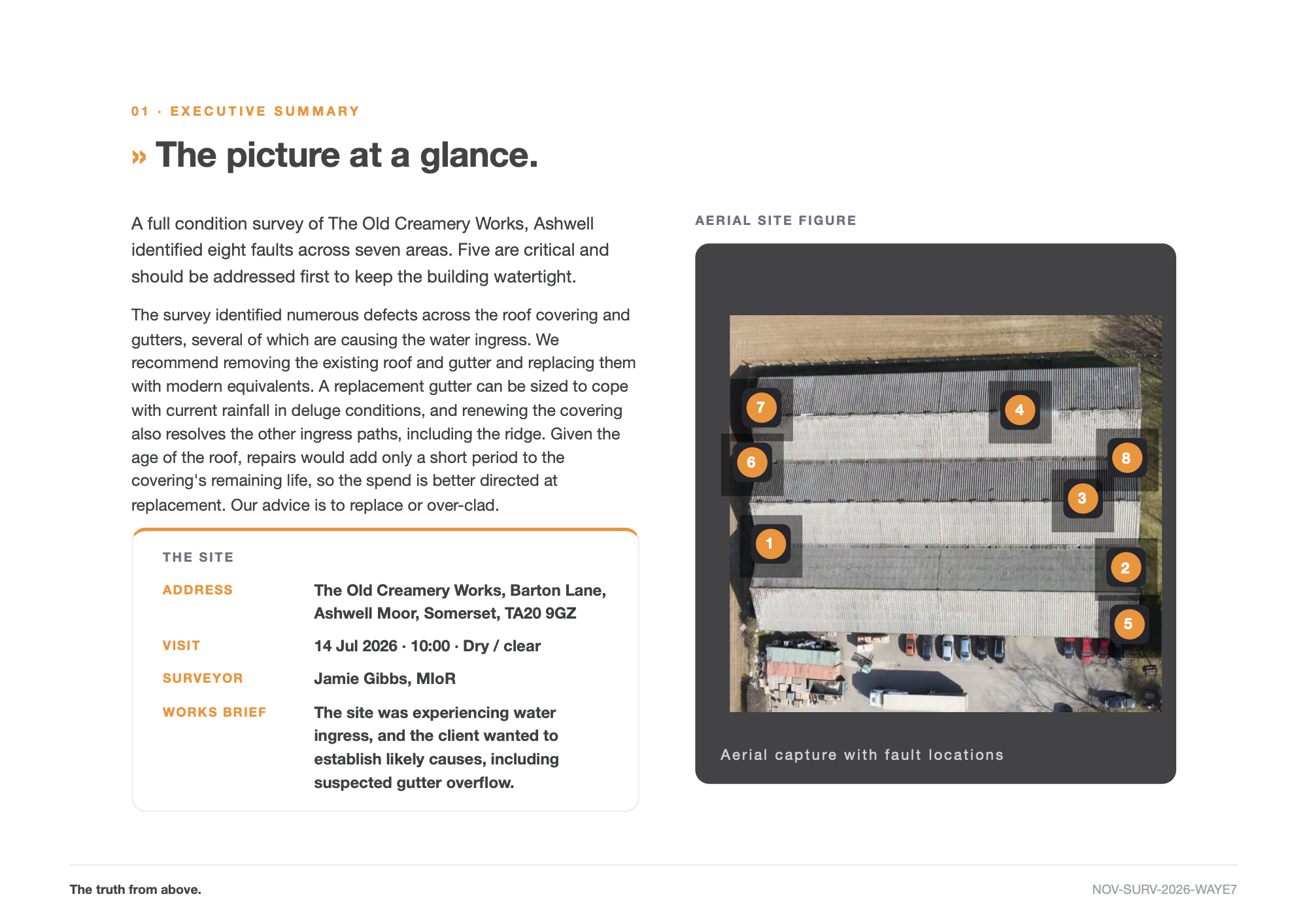


The full document is yours to keep. Sixteen pages covering every fault, the photo evidence, and the costed options.
Download the full sample report (PDF)
Illustrative specimen. Based on a real survey, client identity anonymised.
Cost and timing
Surveys are quoted as a fixed fee before we attend. If you appoint us to carry out the work the survey recommends, the fee is credited against the contract. There is no obligation to use us for the works. Commissioned condition surveys, dilapidations schedules and acquisition reports are quoted as professional services in their own right, with the scope and fee agreed up front.
For a single building, on-site inspection typically takes one to three hours depending on roof area, access and complexity. The written report follows within five working days of the inspection.
For estate and portfolio surveys, we agree a programme with you based on the number of buildings and their geography. The consolidated report covering all sites is produced as a single deliverable at the end of the programme.
If the report recommends work, we set out the scope and price in writing before anything is agreed. Variations are the exception in our contracts, not the business model.
The faults we find, and what they mean.
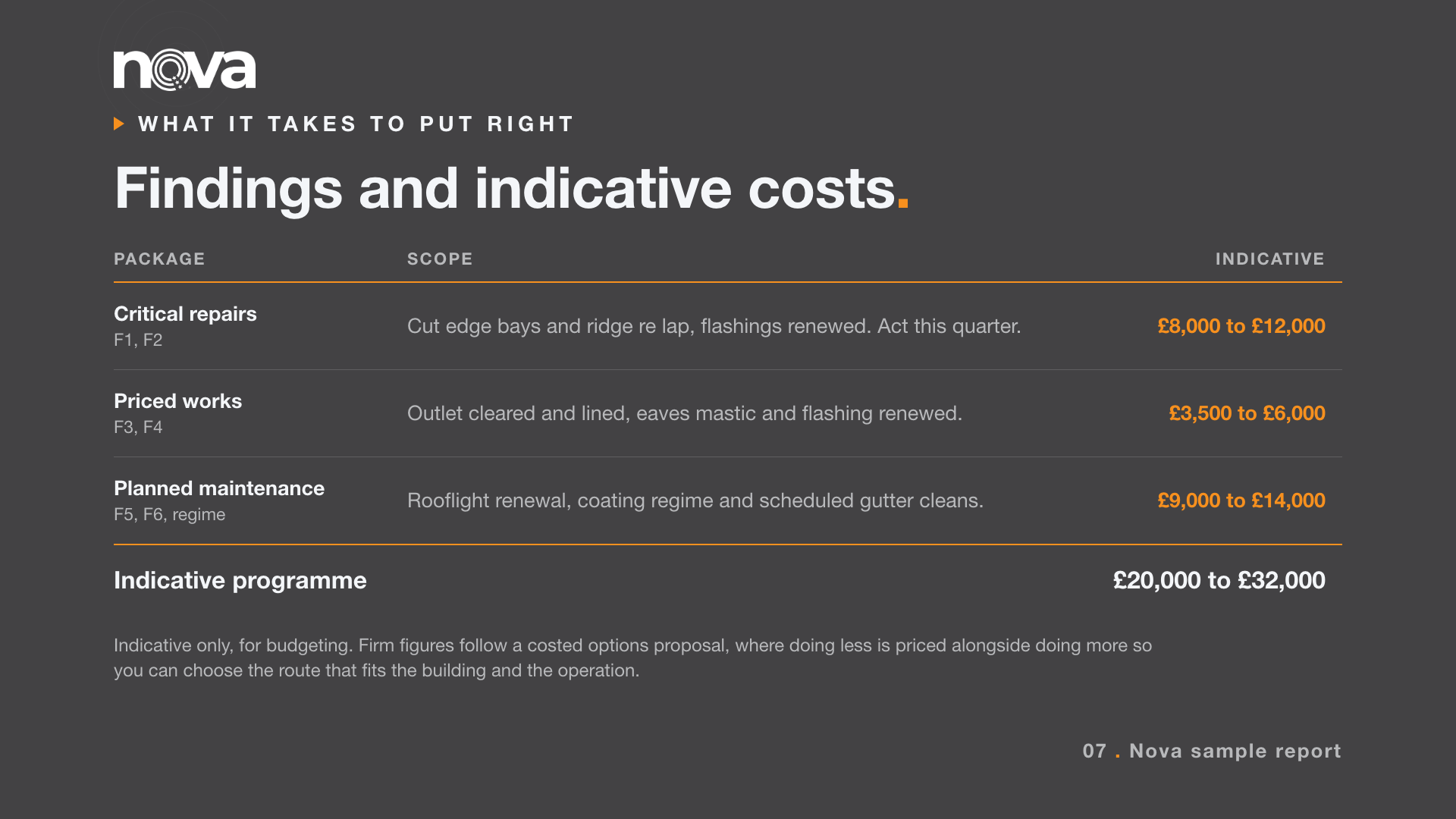
What a Nova survey looks for, and what it finds. Cut edge corrosion, standing water, blocked gutters, failing rooflights and repairs that only bought time. Everything located, rated by severity, and costed in the written report.
Common questions about roof surveys
Is the survey free?
Surveys are quoted as a fixed fee before we attend, so the cost is clear from the outset. If you then appoint us to carry out the work the survey recommends, the fee is credited against the contract.
Does the building need to close during the survey?
No. Drone inspection means the roof can be assessed without walking it and without any disruption to operations below. For most commercial and industrial buildings, the survey takes place entirely above the roofline. Staff, tenants and operations continue as normal.
How long does a roof survey take?
A single building survey typically takes between one and three hours on site, depending on roof area, complexity and access. The written report follows within five working days. For multi-site estate surveys, we agree a programme based on the number of buildings and geography.
Can you survey multiple buildings and give me one report?
Yes. For estates and portfolios, we survey every site and return a single consolidated report with a condition rating and cost plan per building. You get the full picture for capital planning from one document rather than a separate report per building.
Is a drone survey as thorough as a physical inspection?
For most commercial roofs the two work best together. The flight shows the whole surface and how defects are spread across it; close inspection confirms what the footage suggests, particularly at laps, upstands, outlets and penetrations.
What does the written report contain?
The report covers: the roof area surveyed and its construction type; defects identified with their location and probable cause; a condition assessment; a prioritised recommendation; costed options for each route forward; and annotated imagery with every finding referenced to a photograph. Estate survey reports include a summary table with an RAG condition rating and cost plan per building.
Can I use the survey report for dilapidations or insurance?
Yes. The report documents condition clearly with dated, annotated photographic evidence. We are construction-law qualified.
What if the survey finds something unexpected?
We report it. If the inspection reveals a condition that was not apparent from the initial brief, it goes into the written report. The purpose of the survey is to establish what is actually there, and that means reporting everything we find, including things you may not have expected.
Arrange a survey
Tell us the building and what prompted the call. We will confirm the survey fee and a date in writing.